
$A$ particle moves along a circle with a constant angular speed $\omega$. Its displacement,with respect to the initial position of the particle at time $t = 0$,is plotted against time. The graph would look like:
- A
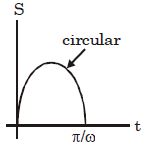
- B
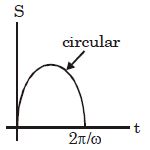
- C
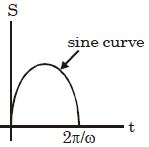
- D
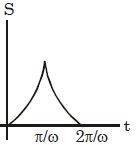
Explore More
Similar Questions
$A$ body is projected at $t=0$ with a velocity $10 \ m/s$ at an angle of $60^{\circ}$ with the horizontal. The radius of curvature of its trajectory at $t=1 \ s$ is $R$. Neglecting air resistance and taking acceleration due to gravity $g=10 \ m/s^2$,the value of $R$ is: (in $m$)
$A$ particle of mass $M$ is moving in a horizontal circle of radius $R$ with uniform speed $v$. When the particle moves from one point to a diametrically opposite point,its
Particles $A$ and $B$ are moving with constant velocities along the $x$ and $y$ axes respectively. The graph of the separation $S$ between them with time $t$ is:
Difficult
View SolutionTwo particles having mass $M$ and $m$ are moving in a circular path having radius $R$ and $r$. If their time periods are the same,then the ratio of their angular velocities will be:
$A$ particle of mass $1 \ kg$ is projected with an initial velocity $10 \ ms^{-1}$ at an angle of projection $45^{\circ}$ with the horizontal. The average torque acting on the projectile, between the time at which it is projected and the time at which it strikes the ground, about the point of projection in $Nm$ is:
Vedclass Products
For Students
Vedclass Test Series
Mock tests in real JEE/NEET style with performance analysis. 5-day free trial.
Start Free TrialFor Teachers
Exam Paper Generator
Generate Set A/B/C/D exam papers from 7.5L+ questions in 2 minutes. 3 chapters free.
Try FreeFor Institutes
Online Exam Module
Live online exams with unlimited students, 360° analytics & white-label branding.
See Demo